 Skip to content


The Ultimate Guide to Jewelry Display: Elevating Retail Sales in 2026
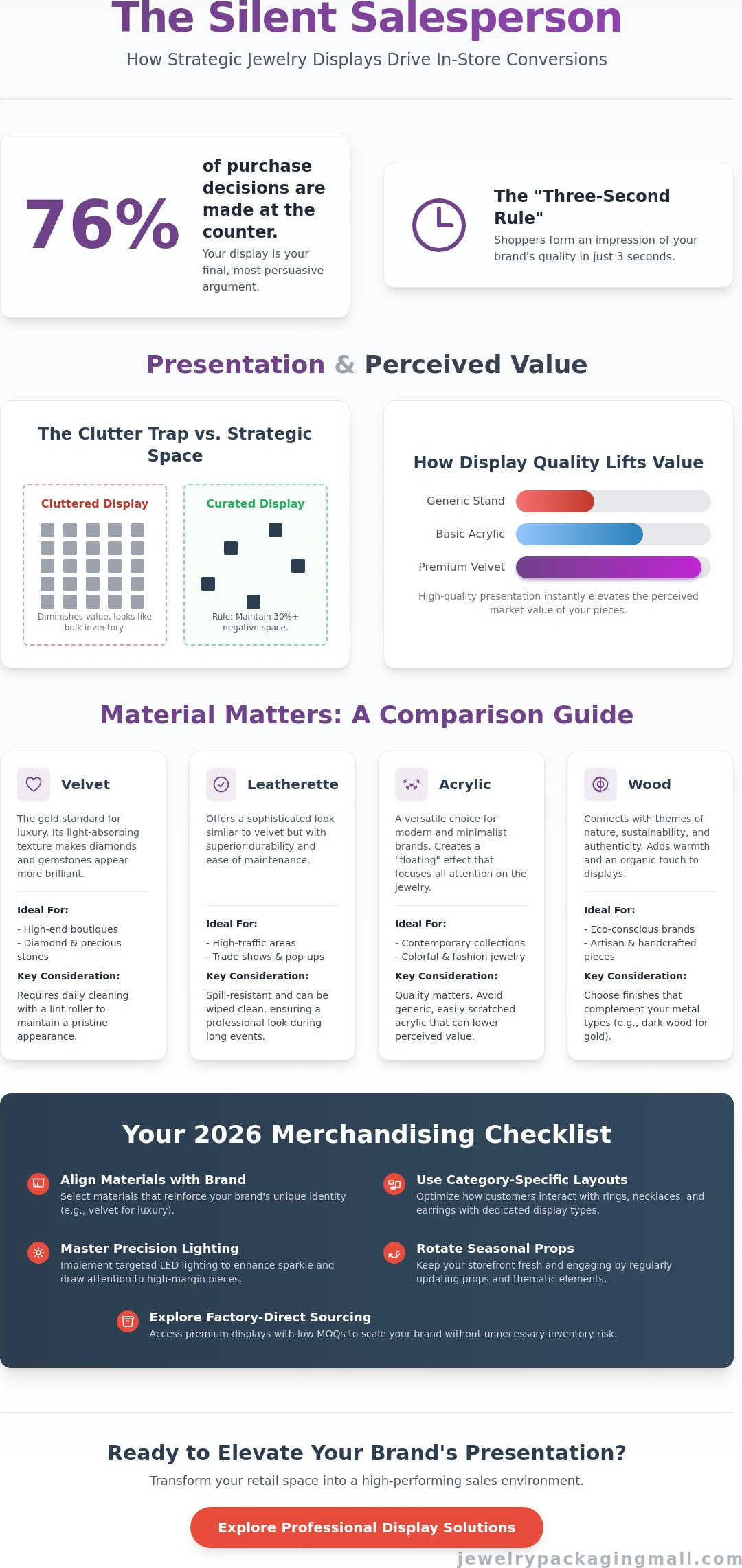
Did you know that 76% of retail purchase decisions are made directly at the counter? This 2023 data from the Point of Purchase Advertising International highlights why your jewelry display strategy is more than just a background; it's a silent salesperson. You probably recognize the frustration of watching a potential client walk away because a cluttered counter or inconsistent branding felt overwhelming rather than inviting. High-end pieces deserve a presentation that reflects their value, yet many retailers still struggle with displays that cause tarnish or fail to tell a cohesive brand story.
This guide will help you master the art of visual merchandising with expert insights on choosing displays that turn browsers into buyers. You'll learn how to create a sophisticated aesthetic that increases customer dwell time and protects your inventory from environmental damage. We'll examine the specific 2026 trends in modular layouts, customizable materials, and factory-direct solutions that elevate your brand while driving higher conversion rates. By the end of this article, you'll have a clear roadmap to transform your retail space into a high-performing sales environment that reflects the premium quality of your collection.
Key Takeaways
- Understand the "Three-Second Rule" and how strategic presentation acts as your most effective silent salesperson in high-traffic retail spaces.
- Learn to select the right jewelry display materials—from classic velvet to modern acrylic—to align your physical presentation with your brand’s unique psychological profile.
- Discover category-specific layout strategies that optimize how customers interact with rings, necklaces, and high-value pieces to maximize conversion rates.
- Master advanced merchandising tactics for 2026, including precision LED lighting techniques and seasonal prop rotations that keep your storefront fresh and engaging.
- Explore how factory-direct sourcing and low minimum order quantities allow you to scale your brand with premium displays without unnecessary inventory risk.
The Psychology of Jewelry Display: Why Presentation is Your Best Salesperson
Your jewelry display acts as the silent closer on your retail floor. It represents the final, most critical link in the communication loop between your brand identity and the customer's intent to buy. In a 2023 retail environment study, data showed that shoppers form a definitive opinion about a store's premium status within just three seconds. This "Three-Second Rule" dictates whether a passerby stops to look or continues walking. Effective visual merchandising transforms a standard glass case into a high-conversion sales tool by capturing immediate attention through deliberate structure and lighting.
The relationship between presentation quality and the perceived value of a gemstone is absolute. If a high-clarity diamond is placed on a worn or generic acrylic stand, its perceived market value drops instantly in the buyer's mind. Transitioning from functional storage to strategic storytelling allows you to elevate your brand. Instead of simply "housing" inventory, you use curated props to build a narrative of luxury and exclusivity. This psychological shift makes the customer feel they're investing in a legacy rather than just purchasing a commodity.
How Displays Influence Perceived Value
The contrast effect is a primary psychological driver in retail. Darker backgrounds, such as charcoal velvet or deep navy microfiber, make colorless stones pop with greater brilliance. Conversely, 18k gold pieces gain a warmer, more inviting glow when set against cream or beige textures. Height and layering are equally vital; placing premium items on elevated risers forces the eye to settle on them first, signaling their importance. Visual hierarchy in a retail jewelry context is the strategic arrangement of products and props to guide the customer’s eye toward the most valuable or high-margin pieces first.
Avoiding the "Clutter Trap" in Retail
Over-displaying is a common error that diminishes the perceived rarity of your items. When a display case is crowded with fifty different rings, the individual beauty of each piece is lost, and the collection begins to look like bulk inventory. For high-ticket items, a "less is more" philosophy is essential for maintaining a premium brand image.
Retailers can create powerful focal points by utilizing professional jewelry display props for retail stores that provide physical separation between collections. It's recommended to maintain at least 30% "negative space" or breathing room within your showcases. This balance between inventory density and aesthetic space ensures that each piece feels exclusive and worth the investment. By sourcing factory-direct display solutions, you can achieve this sophisticated look while keeping your overhead manageable.
Comparing Display Materials: Velvet, Acrylic, and Wood
Choosing the right jewelry display material is a strategic retail decision that directly influences conversion rates. To succeed in the 2026 retail landscape, store owners must engage shoppers' five senses to create a memorable brand experience. The tactile quality of your fixtures tells a story about your price point and brand values before a customer even touches the product.
Velvet and Leatherette: The Classic Luxury Choice
A velvet necklace display bust remains the gold standard for high-end boutiques because its light-absorbing properties make diamonds and precious stones pop. Maintenance is critical; staff should use an adhesive roller every 24 hours to keep surfaces lint-free. For high-touch environments like trade shows, leatherette is often superior. It offers the same sophisticated look but resists spills and can be cleaned with a simple damp cloth, ensuring a professional appearance throughout a three-day event.
Acrylic and Wood: Modern and Sustainable Aesthetics
Contemporary brands use acrylic jewelry display stands to create a sleek, "floating" look. This transparency works well for minimalist designs, allowing the metalwork to be the primary focus. Conversely, the 2024 shift toward eco-conscious retail has boosted the demand for a wooden jewelry display tray. Wood provides an organic warmth that resonates with shoppers looking for authenticity and sustainability. Mixing these materials creates a multi-dimensional identity that feels both modern and grounded.
Material safety is a technical requirement that many retailers overlook. Low-quality fabrics and adhesives can contain sulfur or acidic compounds that accelerate tarnish on 925 silver and 14k gold. Professional-grade displays are engineered with tarnish-resistant linings to protect your inventory investment. When you're ready to scale, factory-direct sourcing provides a significant cost-benefit. Buying in bulk directly from the manufacturer ensures your jewelry display remains consistent across multiple locations while reducing overhead costs by up to 30% compared to local wholesalers.
If you're looking to refresh your store's aesthetic, you can browse our premium display collections to find the perfect match for your brand identity.
Strategic Layouts for Different Jewelry Categories
Effective retail environments don't rely on a one-size-fits-all approach. Your jewelry display strategy must adapt to the specific dimensions and price points of your inventory to maximize sell-through rates. High-value items, such as engagement rings, require individual velvet or leatherette fingers to signal exclusivity. Conversely, multi-ring trays are ideal for stackable bands or silver collections, allowing customers to compare styles quickly. Data from 2024 retail audits indicates that verticality is often underutilized. Using earring trees and tiered bracelet stands can reclaim up to 60% of your counter surface area, creating a more organized and professional aesthetic.
Lighting and drape are the two most critical factors for necklaces. A pendant that hangs poorly won't catch the light correctly, which can lead to a 15% decrease in customer inquiries. Using weighted busts ensures that chains remain taut and centered. For premium gold or diamond pieces, 4000K to 5000K LED spotlights provide the crisp white light necessary to trigger the "fire" in the stones. This technical precision, combined with the psychology of sensory retail, encourages shoppers to interact with the merchandise, which significantly increases the likelihood of a final sale.
Optimizing Ring and Small Accessory Displays
Visibility is the primary goal for small items. A 2024 study by the Retail Design Institute found that slanted trays at a 45-degree angle increase visibility by 35% for standing customers compared to flat layouts. For high-value engagement rings, use LED-integrated boxes within your showcase. These self-contained light sources eliminate shadows and make the center stone the focal point. To boost your average transaction value, place impulse-buy items like jewelry cleaning cloths or small stud earrings within 24 inches of the point of sale. This strategic placement capitalizes on the final moments of the shopping journey.
Showcasing Statement Pieces: Necklaces and Sets
Grouping matching sets requires a balance between cohesion and clutter. Instead of crowding a single bust, use staggered heights to create a dynamic visual path. This technique prevents the eye from becoming overwhelmed and helps each piece stand out. The Rule of Three suggests that grouping items in odd numbers creates a visual center of gravity that holds a customer's gaze 20% longer than even-numbered arrangements. Jewelry Packaging Mall offers customizable busts in varying heights to facilitate this layered look. By adjusting the elevation of your jewelry display, you guide the customer's eye through the collection, highlighting the craftsmanship of both the primary necklace and the coordinating accessories.
Visual Merchandising Tactics for 2026: A Retailer Checklist
Modern retail success depends on sensory engagement and digital efficiency. A 2024 retail study found that 78% of shoppers prefer stores with interactive elements. To stay competitive, your jewelry display must evolve beyond static glass cases. Retailers should implement a rotating checklist to ensure the sales floor remains dynamic and effective.
- Lighting Precision: Use 3000K warm LEDs to enhance the rich tones of yellow gold and rose gold. Switch to 5500K to 6000K cool white LEDs for silver, platinum, and diamonds to maximize scintillation.
- Strategic Seasonality: Update display props every 60 days. Deep velvet textures work for Q4 holiday rushes, while light linen or stone finishes suit spring collections.
- The Interaction Zone: Design "try-on" stations that encourage safe customer contact. Open-access displays can increase sales by 22% compared to fully locked environments.
- Digital Storytelling: Integrate QR codes into display stands. Data shows 42% of luxury buyers scan these codes to verify ethical sourcing or view "behind-the-scenes" craftsmanship videos.
Lighting Your Display for Maximum Sparkle
Light placement is just as vital as the bulb type. Position overhead lights at a 45-degree angle to prevent harsh shadows on the display tray. This angle ensures light hits the facets of gemstones directly. Mirrored surfaces inside the case play a critical role by bouncing light into the pavilion of a diamond, increasing its brilliance. Retailers must maintain consistent lighting across the showroom. If the light quality shifts between the case and the mirror, the gemstone's color representation will appear inaccurate, leading to customer hesitation.
Creating a Cohesive Brand Experience
Consistency builds trust. Your jewelry packaging must mirror the materials used in your physical jewelry display. If your brand uses walnut wood stands, your boxes should feature similar natural textures or eco-friendly kraft finishes. Custom logo imprinting on display bases is a proven tactic, as it increases brand recall by 30% during the browsing process. Ensure this aesthetic carries over to social media. When your physical store's lighting and props match your Instagram photography, it creates a seamless transition for the customer. This professional alignment signals quality and attention to detail at every touchpoint.
Elevate your retail presentation and drive higher conversion rates by exploring our professional jewelry display collections today.
Sourcing Professional Displays with Jewelry Packaging Mall
Sourcing your retail assets directly from a manufacturer like Jewelry Packaging Mall provides a distinct competitive edge in the 2026 market. Factory-direct pricing eliminates middleman markups, often saving brands between 15% and 25% on their initial setup costs. These savings allow growing jewelry labels to reinvest in high-quality inventory while maintaining a premium store aesthetic. Our "No MOQ" policy is a strategic advantage for boutique owners. It lets you test a new jewelry display style, such as a specific microfiber bust or a modular ring stand, without the risk of overstocking items that might not fit your evolving brand vision.
Customization is the cornerstone of professional retail. We provide hot stamping and silk screening services to transform standard props into bespoke brand ambassadors. Hot stamping offers a metallic, indented finish that screams luxury, while silk screening provides crisp, vibrant logo placement for modern, minimalist designs. With worldwide shipping logistics already established, we support your expansion into international markets, ensuring your displays arrive safely whether you are opening a flagship in New York or a pop-up in London.
Elevating Your Brand with Custom Displays
Requesting custom logo imprinting is a streamlined process. You provide a high-resolution vector file, and our production team handles the precision placement on your chosen props. Matching display colors to your existing brand palette is equally simple. We work with specific hex codes and material swatches to ensure your 2026 seasonal collection looks cohesive across all channels. For multi-location retail chains with 10 or more storefronts, we offer tiered bulk discounts. This scalability ensures that as your business grows, your cost per display unit decreases, protecting your bottom line during rapid expansion.
Ready to Transform Your Showcase?
The transition from a cluttered showcase to a high-converting retail environment starts with intentional selection. A professional jewelry display strategy doesn't just hold your products; it tells their story and justifies their price point to the consumer. Before you finalize your wholesale order, use this quick checklist to ensure maximum impact:
- Verify that the material textures complement your metal types.
- Confirm that the display heights work with your existing shelf spacing.
- Ensure your logo placement won't be obscured by the jewelry itself.
- Check that you've ordered enough units for both window displays and interior counters.
Professional presentation is an investment that pays dividends in customer trust and increased sales velocity. If you're ready to upgrade your retail space with the latest 2026 trends, we're here to help. Browse our complete 2026 Jewelry Display collection to find the perfect foundations for your brand's success.
Future-Proof Your Retail Strategy for 2026
Retail success in 2026 depends on mastering the visual narrative. Industry studies indicate that 70% of retail purchase decisions occur at the shelf, which highlights why your jewelry display strategy is your most effective sales tool. By selecting the right materials and implementing strategic layouts, you create an environment where luxury feels accessible. You don't have to navigate these design challenges alone.
Jewelry Packaging Mall serves as your professional partner in this evolution. We provide factory-direct pricing with no MOQ, allowing you to scale your presentation without financial barriers. Every order benefits from worldwide shipping from Hong Kong and expert customization options that reflect your brand identity. It's time to turn your storefront into a high-performance sales engine.
Elevate your brand with factory-direct jewelry displays
Your journey toward a more sophisticated retail presence starts with a single display. We're ready to help you build a brand that customers remember long after they leave your store.
Frequently Asked Questions
What is the best material for a jewelry display to prevent tarnish?
Treated microfibers and acid-free velvet are the best materials to prevent tarnish. Standard fabrics often contain sulfur, which accelerates oxidation by 40% in humid environments. You'll protect your inventory and reduce polishing time by choosing chemically neutral linings. These materials act as a barrier against atmospheric moisture. It's a practical investment that keeps silver and gold pieces looking factory-fresh for 12 months or longer.
How do I choose the right height for my jewelry display stands?
Select heights ranging from 4 to 12 inches to create a dynamic visual hierarchy. Using three distinct levels prevents your showcase from looking cluttered and flat. Retail data indicates that tiered arrangements increase customer engagement by 25% compared to single-level layouts. Place your most expensive statement pieces on the tallest stands to draw the eye first. This strategy guides the shopper's gaze through your entire collection systematically.
Can I customize jewelry displays with my store logo?
You can certainly customize your displays with a store logo using hot stamping or silk screening techniques. Brand elevation depends on these small details that signal professional scale to your clients. Statistics show that 78% of consumers perceive brands with custom packaging and displays as more trustworthy. We provide factory-direct customization options that integrate your brand identity directly into the retail environment. It's a sophisticated way to build long-term brand equity.
Should I use black or white displays for silver jewelry?
Darker backgrounds like black, navy, or charcoal are superior for showcasing silver jewelry. These colors provide a high-contrast backdrop that makes the cool tones of silver and white gold stand out. White displays often wash out the metallic shine, reducing visual impact by nearly 30% in bright light. Using black velvet or leatherette creates a premium feel that emphasizes the intricate details of your silver pieces.
What are the essential jewelry display props for a new retail store?
A new retail store requires a foundational kit of ring cones, necklace busts, earring stands, and stackable trays. These essential jewelry display props ensure you can present every category of your inventory professionally from day one. Most boutique owners start with 20 to 25 core pieces to populate a standard showcase. This variety allows for flexible merchandising as your stock changes. High-quality props elevate your brand's perceived value immediately.
How do I clean and maintain velvet jewelry displays?
Clean velvet displays using a high-tack lint roller or a soft-bristled brush to remove surface debris. You should perform this maintenance once a week to prevent dust buildup from dulling the fabric's sheen. For deeper stains, a slightly damp cloth with mild soap works, but don't soak the material. Regular upkeep extends the life of your jewelry display by 24 months, ensuring your presentation always looks exquisite and sophisticated.
What is the difference between a jewelry tray and a jewelry bust?
A jewelry tray is designed for high-volume organization, while a jewelry bust is meant for artistic focal points. Trays allow you to show 12 to 24 items in a compact space, making them ideal for rings or charms. Busts mimic the human form to show how a necklace hangs naturally. Using a combination of both is vital; items displayed on busts see a 35% higher interaction rate from browsing customers.
How does lighting affect the look of my jewelry display?
Lighting with a Color Rendering Index (CRI) of 90 or higher dramatically improves how your jewelry looks. Using 5000K cool white LEDs highlights the sparkle of diamonds, while warmer 3000K tones enhance gold. Poor lighting can make high-end gems look dull, potentially decreasing sales opportunities by 15% during peak hours. Accurate lighting ensures customers see the true color and clarity of every piece, which builds confidence in their purchase.